San Jose Mercury News Covers Mahabir Pun

June 20th, 2010 by administrator · No Comments

Mike Cassidy of San Jose Mercury News has written a nice piece on Mahabir Pun’s work - http://www.mercurynews.com/ci_15318738?IADID=Search-www.mercurynews.com-www.mercurynews.com&nclick_check=1 (Mike - we hope it’s okay to publish it here as well)

Cassidy: Mahabir Pun inspires digital revolution in the Himalayas

By Mike Cassidy
Mercury News Columnist
Posted: 06/17/2010 01:11:44 PM PDT
Updated: 06/18/2010 07:28:46 AM PDT

It’s not every day that you get a request to connect on LinkedIn.

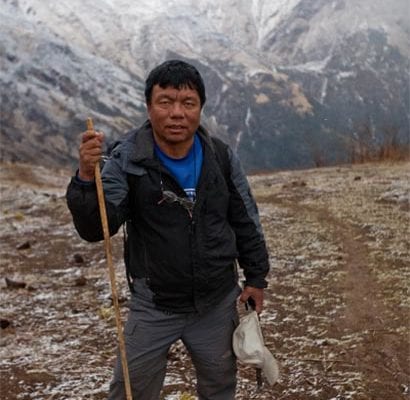
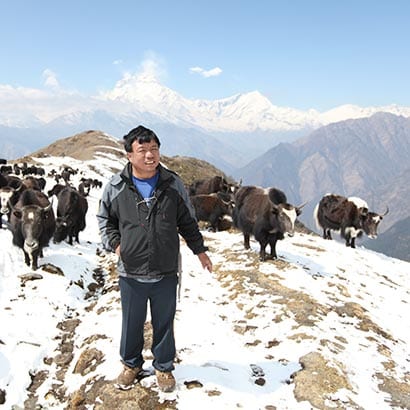
OK, it is, but this particular one stopped me cold: Mahabir Pun was looking to reconnect. Mahabir Pun. He’s a guy I’ve written about, a guy who lives at 7,000-plus feet in a Himalayan village of subsistence farmers in Nepal. He is a dreamer and, it turns out, a doer.

Back in 2003 I wrote about how with the help of a San Jose-based family foundation and others the University of Nebraska graduate had returned to Nangi in Nepal to help start a high school and to try to connect his remote village to the Internet.

Crazy, right? Bring the Internet to a village of 800 without telephones or electricity or really much hope. Except it wasn’t crazy. This Mahabir Pun did it. A guy I got to know through the e-mails that he would travel for hours by foot and bus to send from an Internet cafe got it done. He had a lot of help, including from a college kid who recently graduated from Stanford University medical school.

And connecting Nangi to the rest of the world wasn’t the half of it. Or even 1/80 of it.

“Now more than 80 villages in nine districts of Nepal have been connected to the network,” Pun wrote to me. “The approximate population of the area covered by the wireless network is about 60,000. We are adding more villages with time and still are working to connect more villages.”

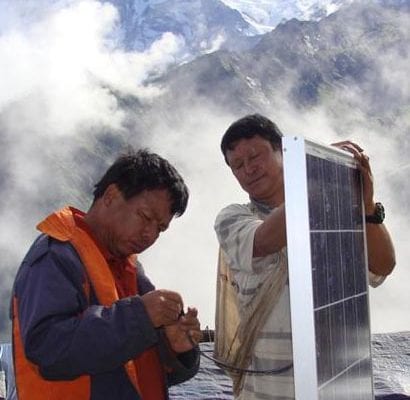
For those of us in Silicon Valley, the Internet has become like running water. We use it every day, many times a day, without much of a thought. But for the yak herders and farmers in the Himalayas, the ability to suddenly reach around the world, or even to the next village, is transformational. The initiative, called the Nepal Wireless Network, relies on solar power and relay stations to connect the remote villages with an Internet service provider in Pokhara, about 22 miles from Nangi, as the crow flies.

Pun wrote that villagers are using the Web to communicate on online bulletin boards. He and those helping him have introduced telemedicine to the mountains. A big city hospital is connected to nine rural hospitals and clinics. Students at the school in Nangi, which has expanded to K-12, are logging on to the Internet to do research.

“People are using the Internet phone to make international calls to their relatives working abroad. We are providing virtual ATM service for the tourists to pay their bills and get cash in the mountain villages. We are also using the network for a trial to get weather information for a mountain village through the Internet. We are working with a researcher from the University of Maryland to monitor the climate change in the Himalayas for which we will collect real time data through the Internet.”

Imagine. All that in seven years. Pun is the first to point out that he’s gotten a lot of help from an army of volunteers and donors. Some of them learned of Nangi while trekking in the area. Others read about Pun on his site at www.nepalwireless.net or in media reports as his effort became more widely known. Mark Michalski, the former Stanford med student, heard about Pun from his friend Robin Shields. The two traveled to Nepal in 2003, armed with a $10,000 Donald A. Strauss Foundation grant and eventually got an Internet connection running in Nangi.

“The funny thing now, looking back, there was very little doubt in our minds that this thing would actually work,” says Michalski, who also says some thought the idea was nuts. “And I think Mahabir had a ton to do with that. His confidence that this could work, in fact, he was sure that it would work, made us sure that it would work.”

Philine Rallapalli, who oversees a modest family foundation in San Jose with her husband, Kris, says she sensed the same thing about Pun. When the couple met with him in 2002 to talk about his school idea, she saw a man who was determined to better villagers’ lives.

The Huguenin Rallapalli Foundation donated $16,000 to build the school, and it’s contributed thousands more since. Kris Rallapalli says the results, with the school and the network, have been phenomenal.

“He is so committed to the cause,” he says, “without him, the village would not have done what it’s done. And it’s not just the village. It’s all of Nepal. People like him are the future for these countries to get ahead.”

Pun says he’s determined to help his country do just that. The next step, he says, is to open a four-year college in Nangi by 2015. “We don’t know yet how we will do it,” he says, “but we won’t give up.”

I wouldn’t bet against him.

Contact Mike Cassidy at mcassidy@mercurynews.com or 408-920-5536. Follow him on Twitter at http://twitter.com/mikecassidy.

→ No CommentsTags: Foundation

HEF e-Newsletter: December 2009

January 13th, 2010 by Jiwan Giri · No Comments

Dear Friends and Colleagues:

Happy New Year! Attached is our latest HEF e-Newsletter.  This will provide you an update of all the current accomplishments and status on our project activities.  

HEF Board would like to THANK each person receiving this e-Newsletter for supporting us.  HEF continues to achieve recognized status as a major support base for many project activities helping the people living in rural communities of Nepal.  Your support is very important and makes a major difference in lives of people living in Nepal.

Thank you for signing up for this e-Newsletter of the Himanchal Education Foundation!
Himanchal Educational Foundation
5610 Avenue N
Kearney, Nebraska 68847
Web: www.himanchal.org
Email: contact@himanchal.org


→ No CommentsTags: Foundation

HEF e-Newsletter: Chairman’s Message

January 9th, 2010 by Jiwan Giri · No Comments

Chairman’s Message

Since the time when a few persons in Kearney, Nebraska committed themselves to provide financial support for the teachers at Himanchal High School, it is just amazing how, over a relatively short period of time, that decision has evolved to Himanchal Educational Foundation, with a constantly evolving mission and a nationwide Board of Directors.  The scope of our mission is well reported in this issue of the newsletter. 

 We have also experienced the evolution of a financial support group largely focused in the Kearney area to the current support group that spans USA, Canada, England, Finland, Denmark, Netherlands and probably some others I can’t recall.  Also, the “Nepali Community” all over the US has become a major support group.  It is amazing how many, mostly small, contributions can add up to a significant support group.  The wireless network is a wonderful connection between HEF and the Nepali Community.

 As we begin 2010, we look back at the wonderful support that has passed through HEF.  We also anticipate, with equal wonder, the existing and potential projects that will strengthen the relationship between HEF and Mahabir’s great leadership in Nepal.  HEF is managed by volunteers, permitting us to, literally, direct every dollar to the work in Nepal.

Happy New Year !!!

Leonard Skov

→ No CommentsTags: News

Appeal for Solar Charging Unit

January 9th, 2010 by Jiwan Giri · 3 Comments

We are currently looking for donations to help us buy a portable solar charging unit to use during the project manager’s visits to the villages in Nepal. This portable charger will make it possible for our project manager to update project information and report on timely manner while he is regularly monitoring different projects taking place at the respective villages.


→ 3 CommentsTags: Contribute

US Ambassador to Nepal Honors Mahabir Pun

July 2nd, 2009 by Sandeep Giri · No Comments

Courtesey of Nepalnews.com:

American Ambassador to Nepal Nancy J Powell honoring Mahabir Pun, the recipient of the prestigious Ramon Magasaysay Award, in a programme felicitating 26 social leaders for their special contribution in the field of social development in Nepal, organised by Antenna Foundation in Kathmandu, Wednesday, Jul 02 09.

→ No CommentsTags: Foundation

Himanchal School as seen by Andris Bjornson

March 27th, 2009 by Sandeep Giri · 1 Comment

Khopara community lodge.

Andris Bjornson is a professional photographer who visited Nangi and surrounding areas in Nov-Dec 2008. He took some great shots of the area, and has kindly permitted us to republish here. Check out the mindblowing pictures on our Facebook album (and share yours if you have some good ones from your trips to Nangi!) 

Don’t forget to visit Andris’s site for more pictures and commentary - http://www.andrisbjornson.com/

→ 1 CommentTags: Foundation · School · Village

Robin Shields, Former Volunteer, is Walking Across Nepal

March 25th, 2009 by Sandeep Giri · No Comments

Robin Shields is one of the earliest volunteers to visit Nangi (we need to get your profile page up Robin :-) .. and now, this fall, he will walk all the way across Nepal, east to west, all 900-odd kilometers through the mountains and the valleys on foot.

Here is a link where you can find more information, and send Robin encouragement and also tips on some of the routes where he doesn’t have much information.

→ No CommentsTags: Foundation

Dr Debra Stoner in Nepal March 2009

March 23rd, 2009 by Debra Stoner · No Comments

Namaskar from Dolakha (east of Kathmandu) and Happy St. Patrick’s Day….what a crazy combination! Despite it being the day of the green leprechauns there’s ‘nar a bit of green in these hills as the last of the arid season pelts us with dry, blowing winds. The land is parched and a far cry from the green flowing terraced fields of my last fall visit. But I am getting ahead of myself……

The team of Pediatricians from Geisinger Medical Center spent the first week at Kathmandu Model Hospital teaching Pediatric Advanced Life Support and Neonatal Advanced Life Support to the nursing and physician staff. Several CMA (Certified Medical Assistants) also attended. These are the women and men who work out in the rural areas and have medical educations ranging from a paramedic to a nurse midwife. Medical education in Nepal is taught in English so language wasn’t a huge barrier except with the CMAs….but we broke through with hands on practice and help from the Nepalese doctors and nurses. They did a great job and everyone had a successful mega code test…all the pretend kiddies survived.

Seeing Kathmandu through the eyes of “newbie’s” is almost more entertaining than Kathmandu itself. There has been no lack of surprises and laughter each day as Janis, Lexi, Anna and Tessy marvel or more accurately stare in shock at the unusual sights that define this city. As we toured Pashupatinath, Nepal’s most revered Hindu temple, Anna summed it up the best when she looked around at the sadhu (wandering, painted Hindu holy men) and declared “Dorothy we are not in Danville any more”!

Despite Janis taking out the electric lights in two rooms with her 110V surge protector….electric here is 220V….we have not had too many mishaps. Our most funny misunderstandings occur due to Tessy’s heritage. Born in the USA of East Indian parents she can easily pass for a Nepalese woman. Several times people have approached her speaking rapid Nepali and insist she is Nepali despite our objections. I think we could have offered her hand in marriage a few times too.

They were fortunate…or not…depending on who you ask….to be here during Holi Festival. It’s kind of a water sport festival….a harbinger of the drenching monsoon season to come. And drenched we were….everywhere you go in the city people….well, mostly kids and teenagers….throw water balloons at you…..filled with colored….let me elaborate….day glow colored bright red and orange dyed water. The more ambitious throw buckets of water and balloons from the roof tops. It’s a toss up when walking….look up to avoid a balloon and risk taking a direct face hit or dodge through the streets commando rabbit style.

The second week we were off to Dolakha’s Gaurishankar Hospital for more PALS and NALS…..stay tuned.

Debs

→ No CommentsTags: Foundation

Paper Making Project — We need your help

March 10th, 2009 by Jane Sabin Davis · No Comments

The women started producing paper again this January. So far they have produced 1,454 sheets of 20 grm paper and 91 sheets of 40 gm colored paper.  97 kg of lokta bark has been harvested from Nangi and 194 kg lokta has been harvested from Ramche village in February. We purchased lokta @ Rs.50 per kg. The weather is good and sunny for lokta paper making, so the women are doing a great job.

Chitra Pun

You can help us sell paper products in the US and Canada.  The Himanchal Educational Foundation has a supply of handmade paper writing journals (70 pages/book) for sale.  For a picture, see the earlier post on paper making.

Our homemade Nepali Paper Writing Journals are easy to market.  90% of the times that I have visited businesses in the Northwest, the buyers are happy to purchase our journals @ $10.00/each and sell them at whatever price they want.  We supply bookstores, stationary shops, or small gift shops with everything that they need: information on our Paper Making Project and the Himanchal Educational Foundation, and information on fair trade.

I will send you a demo journal.  Armed with our information, most shop owners are genuinely happy to support a remote village in Nepal where no middle man is involved (taking a portion of the profits).  All you have to do is email jane@himanchal.org to discuss your participation.  Thanks so much.

→ No CommentsTags: Foundation

Blood Drinking Festival - a fundraiser for local schools

March 10th, 2009 by Jane Sabin Davis · 1 Comment

The Blood Drinking Festival was conducted for five days from 02-06 March 2009; there were 205 people involved. All these people are from around the villages of Nangi, Paudwar, Ramche, Shikha , Narchyang, and Pulachour.  During the festival, 11 yak was killed and sold for meat. Blood was sold @ Rs. 60 per cup. A minimum of 12 to maximum of  21 cups of blood were taken from each yak. Blood is drunk as a medicine for intestinal problems and to get energy. Another festival will be conducted at Khopra Hill in mid-July. The total profit was Rs.141,000, which was alloted Rs. 70,500- for each school of Nangi and Paudwar .

Another aspect of the Yak Fundraising Program is the development of yak herds at Mohare Danda. Two male yaks were taken to Danda for the cross breeding project. It took a couple days from Paudwar to Mohare Danda. The villagers and members of committee of Nangi village did hard job to bring yak.

Chitra Pun, Program Officer

→ 1 CommentTags: Foundation